
Check out the New Media Museum’s latest creation — it helps students (and computer history buffs) learn about the history of computing and take field trips to the best (virtual) computer museums in the world! Click the image to find out more!
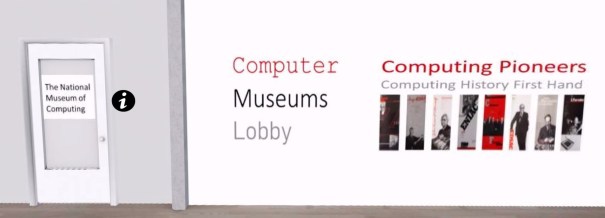
Check out the New Media Museum’s latest creation — it helps students (and computer history buffs) learn about the history of computing and take field trips to the best (virtual) computer museums in the world! Click the image to find out more!
Hi All!
It’s a Friday, before a holiday week!
What better time to provide a new, fun distraction, right?
It’s no secret that, while I love all of the New Media Museum’s Exhibits, Projects and Collections, I’m highly partial to the Immersive Interfaces Exhibit and Immersive Experiences Collections.
That’s why I spent a better part of a decade at Digital Den on related work 🙂
It shouldn’t be a huge surprise that I’ve just dropped a Games & Immersion addition to New Media Museum@Boston.
ICYMI Here’s the full guide to media and computing in the Boston area.
Media & Perception
Harvard’s Mark I & Hopper
MIT’s Whirlwind & Forrester
Artificial Intelligence & Robots
Logo & LEGO
Games & Immersion
Micro Center & MIT Flea
Enjoy & Have a Great, Safe Holiday Week!
Mary
I recently got into a coversation with a colleague about computing related fieldtrips for high school and college students in the Boston area. We agreed that there is plenty to see if you know where to look. It struck me that a list of some of them along with links to related educational resources would be useful for others to have at their fingertips.
Here is a guide to computing related fieldtrips the Boston area.

NMM@Boston
Harvard’s Mark I & Hopper
MIT’s Whirlwind & Forrester
Artificial Intelligence & Robots
Logo & LEGO
Micro Center & MIT Flea
Please share with educators who might find it valuable!
Thanks,
Mary
I have just came back from seeing a preview of the Computer Museum of America (CMoA) that is slated to open in Roswell, GA north of Atlanta later this year. WOW, it’s going to be huge!
Most of us that are into the computer history scene have already been aware that a computer museum has been percolating there for sometime. That’s mostly because the founder of CMoA, Lonnie Mimms, has worked with the Atlanta Historical Computing Society to provide a venue for the Vintage Computing Festival South East (VCF-SE) for the last few years. For anyone who has attended VCF-SE before this year, the big news is that now there is a huge new location that is being renovated to serve as the permanent home of the CMoA.
The new location will be able to house some much larger exhibits, both literally and figuratively. To give you a sense of what I mean by that, take a look at the “virtual exhibit” of Super Computers that you will find on this site.
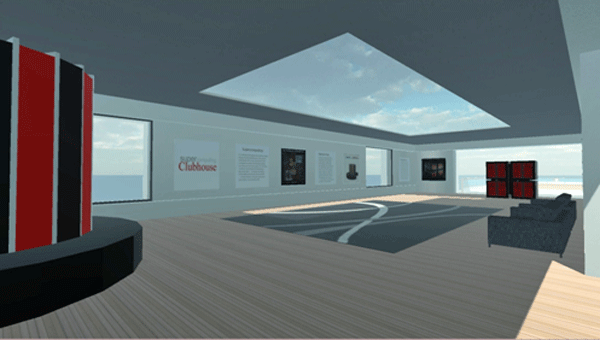
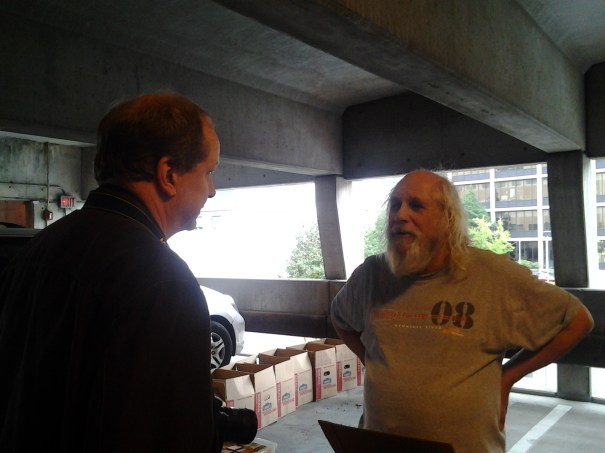
My intention was to take advantage of the “virtual” to be deliberately fanciful. Thus I included the large and rare Cray-1 and Connection Machine-1 (CM-1) for two reasons. The first reason was that they are some of the most recognizable and photogenic systems. The other reason was because I happen to know people who collect such things. Here is a picture of two of them that I snapped when I had the honor of introducing them to each other for the first time at the Flea@MIT back in 2014.
Still, even though I knew who might have or be able to find the systems, I never really believed the exhibit would ever exist because the cost to create and display it would be too prohibitive.
Imagine how exciting it was to see a proto-exhibit of Crays and Thinking Machines in real life! Here’s a Cray-1 swaddled in shipping material.
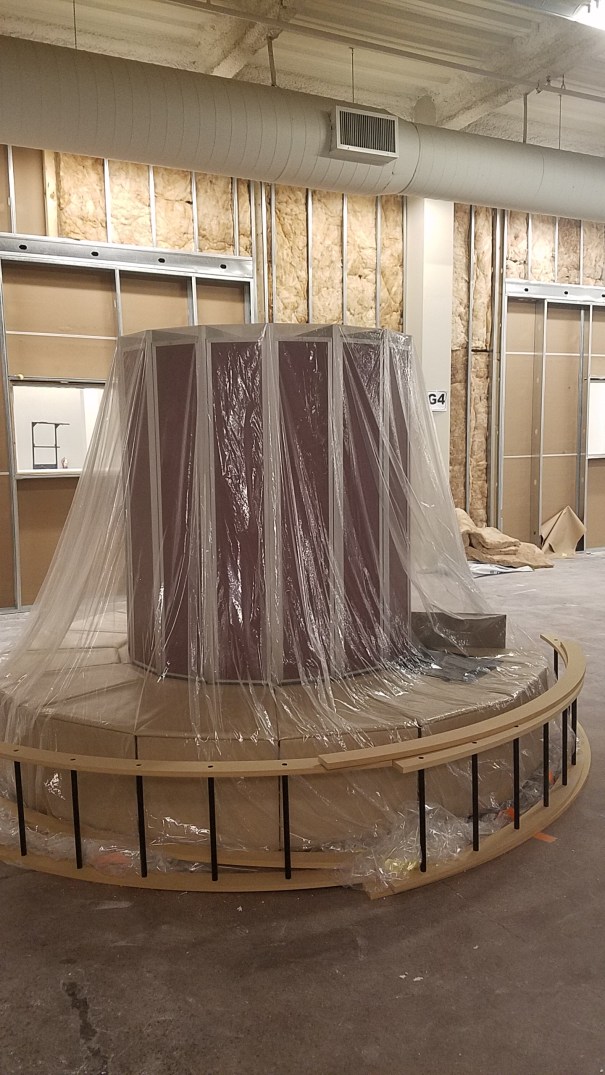
Here are some of its siblings.
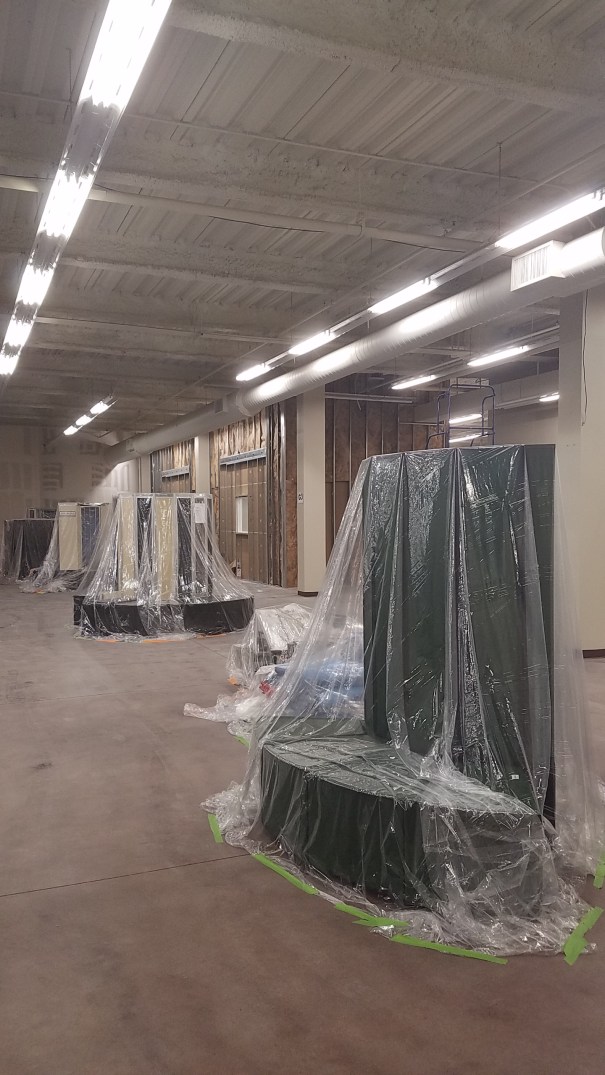
Here is a CM-2 upstaging a Cray X-MP and a couple of its siblings.
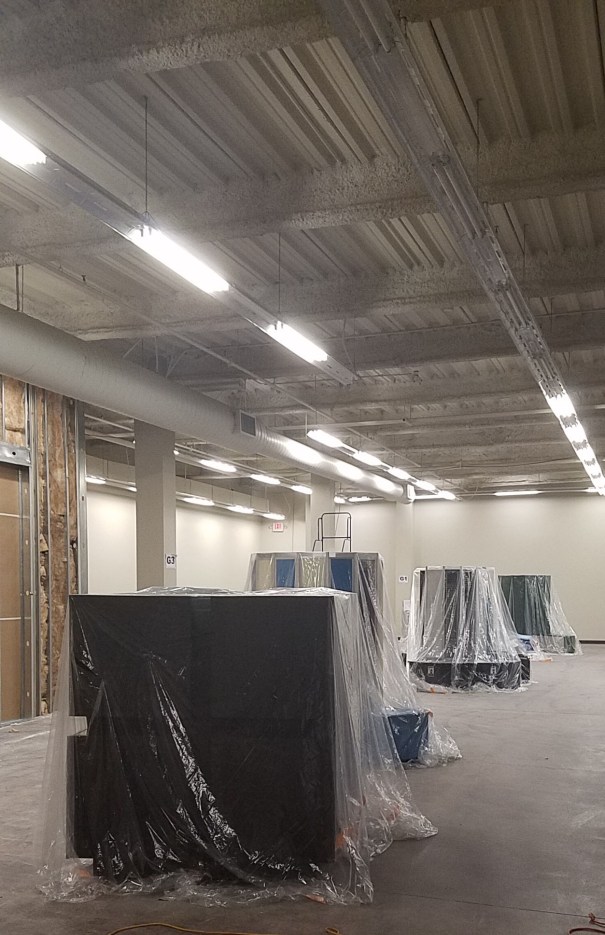
Here’s a CM-2’s DataVault with other interesting systems huddling behind it.
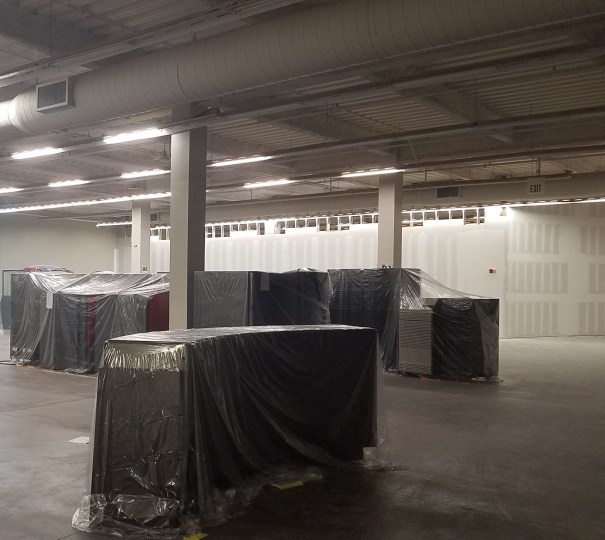
You get the gist, and that is just as sample to help you imagine the scale of what the CMoA will be when it opens this year. There are also a lot of other spaces and plans in the works, and you can find out more about them for yourself on CMoA’s website.
There is no doubt that it will become a “must see” attraction for anyone interested in the history of computing, not only on this coast, but also in this country and around the world.
It had to happen sooner or later. It was inevitable, and so a trip to Silicon Valley Virtual Reality Expo for Digital-Den provided the perfect opportunity, Yes, that long-overdue visit to the Computer History Museum (CHM) in Mountain View, CA finally took place!


BTW If you’re not already familiar with the history of CHM and it’s older incarnation in Boston, be sure to check out the page about it on this site.
It was every bit as impressive as you would expect. The majority of the computers are part of the Revolution Exhibit which covers the entire history of computing from ancient times to the present.


It was so massive, it was overwhelming. Of course, I took hundreds of pictures. However, for you to get a good sense of it, it is best to watch this 40 minute long YouTube video tour by Chris Garcia, a Computer History Museum curator, and none other than Steve Wozniak (Woz).
The video was made back in 2010, but it does a good job of giving a sense of the experience. Here’s a link to the PC World story where I learned about the video.
Steve Wozniak shows us around the Computer History Museum’s first full-blown permanent exhibit: Revolution: First 2000 Years of Computing (Harry McCracken, PC World)
Here’s my close-up of the Apple I exhibit. Notice Woz’s signature!


Of course, I took a few minutes to bond with the robot exhibit.


Then there was the chance to actually see the Utah Teapot with my own eyes, and yes, it is a different shape than it looks in the 3D models!


Then there was also a mandatory stop into the PDP-1 Restoration Room.


Overall, it was an amazing visit. Then the trip came to a very unexpected conclusion. Guess who I met at the airport waiting for the plane home?
Yup, that actually happened!
What an amazing coincidence, as well as a perfect conclusion to the journey. Of course, I’ve got a lovely new little artifact for the collection as well 😉
Seymour Papert passed away in July of last year, and this week I had the privilege of attending the memorial event in his honor held at the MIT Media Lab entitled Thinking about Thinking about Seymour.
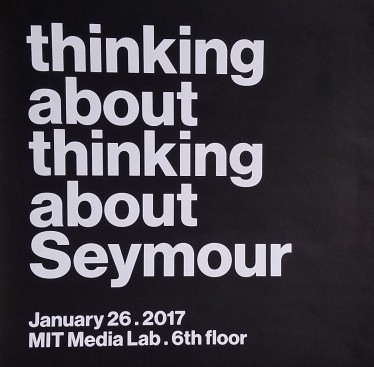
Here are two videos that capture just a bit of what Nicholas Negroponte and Alan Kay had to say about Seymour.
The have also announced that Mindstorms is now available online for free!
Mindstorms: Children, Computers, and Powerful Ideas (Basic Books, 1980)
Seymour may be gone, but there is still a vibrant community of his followers carrying on his work. Gary Stager and Cynthia Solomon are two of the most well known and active members. Cynthia was one of Seymour Papert’s earliest and closest collaborators, and Gary holds yearly events called Constructing Modern Knowledge.
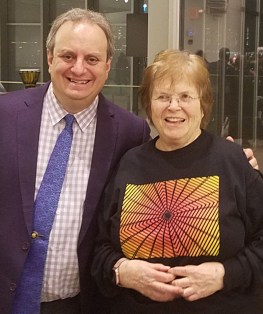
Gary Stager & Cynthia Solomon @
Thinking about thinking about Seymour, January 26, 2017
Here are some links to Logo community resources.
Logo Things (Cynthia Solomon)
Logo Projects (Cynthia Solomon)
Cynthia Solomon (Wikipedia)
You should know Cynthia Solomon (Gary Stager)
Constructing Modern Knowledge (Gary Stager)
Logo Foundation (Michael Temple)
The Design of Technological Tools for Thinking and Learning (Uri Wilensky)
Logo Tree Project (P. Boytchev)
Finally, the exhibit on this site has been freshly updated with the above resources and more. Check it out!
Learning and Computing
Fall is here already, and that means the last Flea@MIT is approaching. Join us on Sunday, October 16th for two back-to-back events.
First, the New Computer Museum will have a table at the Flea from 9 a.m. to noon.
Second, we’ll pack up and head to Champions for a snack from 1 pm to 2 pm.
Stop by, say hi and hear the latest developments!

Marvin Minsky died last Sunday (Jan. 24), of a cerebral hemorrhage at the age of 88. This is an incredibly sad loss to many of us, both near and far — it feels as if a hole has been torn in the fabric of our intellectual universe.
Marvin Minsky, “father of artificial intelligence,” dies at 88 (MIT News)
For those of you who did not know Marvin, here is a brief overview from the Media Lab web site (where he was a co-founder).
Marvin Minsky has made many contributions to AI, cognitive psychology, mathematics, computational linguistics, robotics, and optics. In recent years he has worked chiefly on imparting to machines the human capacity for commonsense reasoning. His conception of human intellectual structure and function is presented in two books: The Emotion Machine and The Society of Mind (which is also the title of the course he teaches at MIT). He received the BA and PhD in mathematics at Harvard (1950) and Princeton (1954). In 1951 he built the SNARC, the first neural network simulator. His other inventions include mechanical arms, hands and other robotic devices, the Confocal Scanning Microscope, the “Muse” synthesizer for musical variations (with E. Fredkin), and one of the first LOGO “turtles”. He has received the ACM Turing Award, the MIT Killian Award, the Japan Prize, the IJCAI Research Excellence Award, the Rank Prize and the Robert Wood Prize for Optoelectronics, and the Benjamin Franklin Medal. –Media Lab, 2015
More importantly, here is a wonderful video clip that the Media Lab highlighted this week that came from what was surely one of his last public appearances during the Media Lab’s 30th anniversary event in October of 2015. It captures the love and respect that his community felt for him as well as his keen wit that led to it.
Marvin Minsky and Danny Hillis: Mind, Magic & Mischief
Media Lab 30th Anniversary, Overview
Media Lab 30th Anniversary, Videos)
For those of you who do not know about the specific connections between Marvin and the New Computer Museum’s collections, check out the Learning & Computing exhibit on this site. Here is a link to a special, seldom seen original video from that exhibit.
Video: Marvin Minsky @ Purdue (1988)
Finally, here is a link to a fully-online version of one of his most famous works.
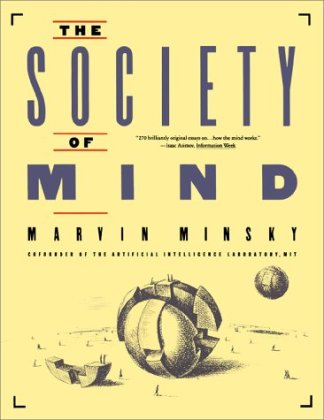
Farewell Marvin, you will be dearly missed!
Related sites
Marvin Minsky (Media Lab)
Marvin Minsky (Wikipedia)
New Computer Museum Updates!
Here are a few quick updates to ring in the New Year!
First, there is a new version of the New Computer Museum application available to download (updated 12/21/15). The application runs on Windows 7/8, and you can download it from the New Computer Museum web site (http://www.newcomputermuseu.org).
Second, this new video shows a quick walk-through of the application. Notice that all of the posters and objects link to interesting content or interactive activities.
Third, as many of you know, the winter months are the slow season for computer history buffs in the Boston area, but the 2016 season is already coming together.
The next Swapfest is April 17th. Here’s a PDF of the poster for the season:
Click to access swapfest-2016.04.pdf
Finally, watch for some good news from us this spring as well.
Happy New Year!
-Mary
I had a major dilemma back in the winter of 2012/2013 when I started to think about making my computer hardware and software collection publicly accessible — where to do it? I definitely didn’t want to invite the general public into my home, so I started to look into renting. I quickly found out that things had changed a lot since the days when I had my computer business in Harvard Square (Studio-E, 1994-1997). The commercial rents in Cambridge have become absolutely mind-blowing — they are literally some of the highest in the world. There was no way I could rationalize paying so much for such a tiny, non-profit mission of making some old computers available to the public for free.
Then one day I was walking by Metropolitan Storage. It was a place that had become near and dear to my heart over the years as I had turned to them again and again for stashing my stuff — I had come to think of them as one gigantic, practically boundless “room of requirement.” My ever expanding collection of computing history had made its way there more than once over the 20 years since I had my business. I had an “aha moment,” walked in and struck a deal. The folks at Metropolitan Storage were absolutely fabulous about helping me get set up. They even painted and wired a space right inside the main door, and they were happy to guide anyone who came looking for me to my new space that I decided to dub “Digital Den.”
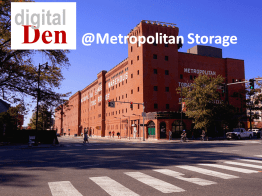

One of my visitors included Hiawatha Bray from the Boston Globe who wrote this article about my new adventure that debuted on the front page of the business section of a Sunday edition. Hiawatha even included a picture of Bill Gates visiting the old computer museum in Boston!
A passion to preserve the digital past (Hiawatha Bray, Boston Globe, August 31, 2013)
The Globe also sent a reporter to shoot a video to go with the story, and the video does a great job of showing the space that the team at Metropolitan Storage custom built for me.
Cambridge museum aims to preserve digital history (Boston Globe Video)
I eventually learned that I was not alone in my quirky choice — I had other neighbors that had also found some interesting, non-traditional uses for their self-storage units. My favorite co-inhabitant was a woman who had worked with the team at Metropolitan Storage to construct a fantasy closet to house her massive collection of clothes. There was also another unit right next door to mine that had a really fantastic, huge custom built study.
Over time I decided that I wasn’t getting enough traffic from the public to rationalize the expense, so I decided to evolve to a “pop-up” model. It made me sad, but I moved my collection back home and let go of my space. I figured I might get another space someday, maybe shift my clothes there instead of computers next time, and go for a closet space, too …
Alas, that isn’t going to happen after all. Early on in my adventure I learned that MIT had actually bought Metropolitan Storage’s property years ago, and so they could choose to use it for something else someday. Sadly, I learned over the summer that MIT has decided to do just that. Many of us in Cambridge have been talking about it for months — where in the world is all that stuff going to go? What are they going to find in those rooms? A dorm, really? How are they going to do that!?! But most of all, what are all of us Cantabrigians going to do without our wonderful, perennial “rooms of requirement?”
Then last weekend the Boston Globe ran a story about the closing, and they included a video capturing the beautiful custom spaces my former neighbors are giving up. It is a bitter-sweet tribute to what is being lost, and it is also sad that only now is everyone seeing the wonderful things that the team at Metropolitan Storage had been doing for its tenants over the years.
A housing boom claims warehouse full of home trappings (Tim Logan, Boston Globe)
Be sure to check out the story and the video. It really is a tribute to an irreplaceable institution that is going to be sorely missed! So long Metropolitan!
 New Computer Museum